




 Back to Articles
Driveway Gate Security: Why a Gate Alone Isn’t Enough for Southern California Homeowners

Share:


Key Points:
- Driveway gates offer homeowners privacy and security, but while a gate may deter crime, it doesn’t stop determined burglars from exploiting vulnerabilities.
- Real protection for homes with gated driveways comes from a combination of access control, locally monitored video surveillance, and active security patrol.
- Post Alarm is uniquely positioned to help Southern California homeowners design a layered system tailored to the specific needs of gated properties.
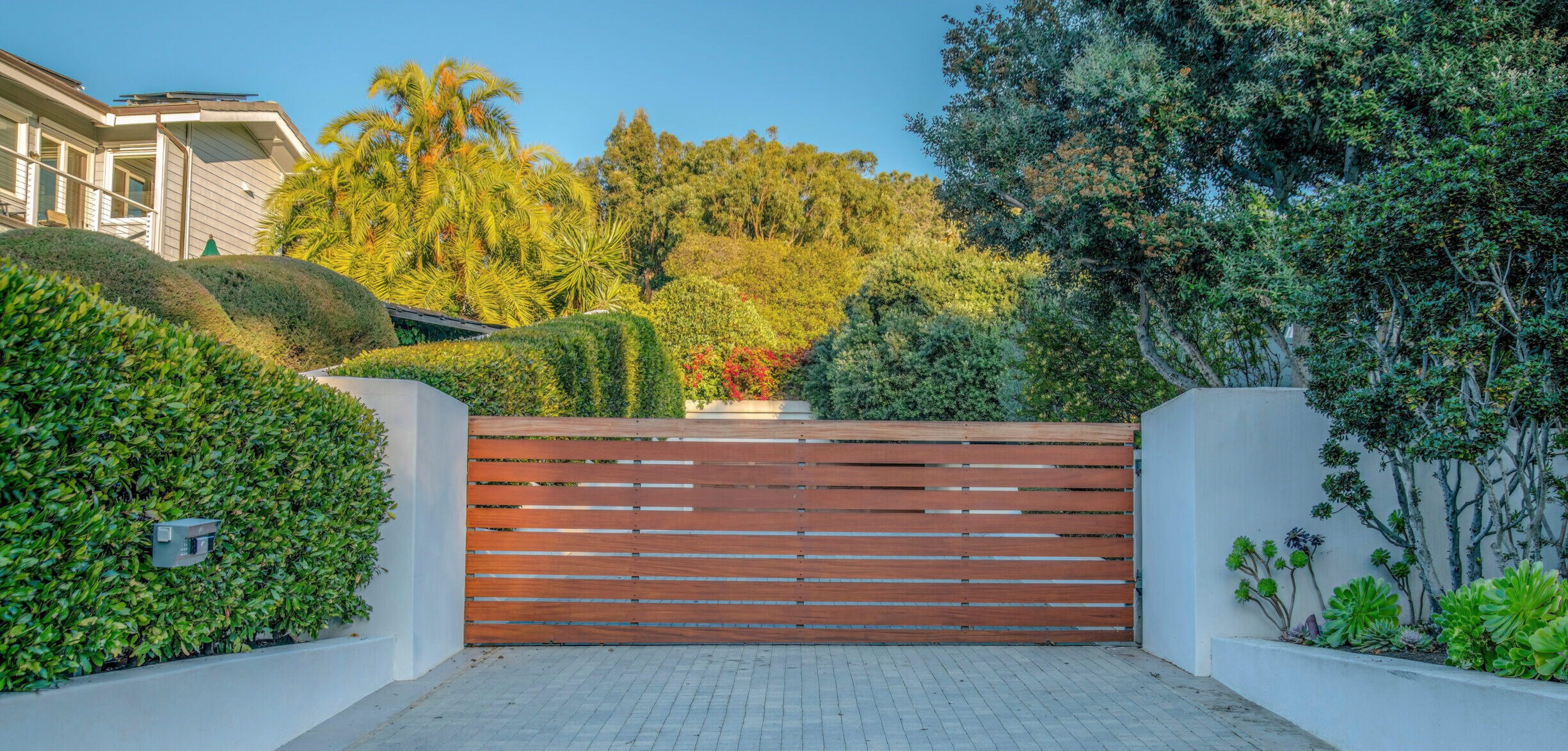
A strong gate at the end of the driveway gives homeowners a sense of security. What many don’t realize, however, is that the gate itself is primarily a deterrent. A gate alone may not stop determined burglars, especially those who have learned to exploit the vulnerabilities inherent to driveway gates and other residential access control measures.
Data collected by the Los Angeles Police Department (LAPD) in 2024 reveals burglary as a rising threat to Southern California residents, even in properties protected by gates. Residential burglaries rose by nearly 40% over a three-year period, but reported arrests during the same window were staggeringly low. The best way SoCal homeowners can avoid becoming a statistic is to take a proactive approach to residential security.
Effective crime prevention doesn’t start and stop at the gate. In this article, we’ll discuss how gate access control can be combined with locally monitored video surveillance and a real-time human response into an effective, layered approach to home security.
Does a Driveway Gate Really Stop Crime?
At a glance, a property surrounded by walls with a gate at the end of the driveway may seem secure. What the owners of such properties often fail to realize, however, is that a gate serves primarily as a privacy booster and physical deterrent. Without additional security measures like patrol, armed response, and monitored video surveillance, even gated properties remain vulnerable to crime.
There are many ways criminals can bypass standard driveway gate security systems:
- Tailgating – Following residents through entry points before the gate closes.
- Forced entry – Ramming the gate or causing damage to the hinges or leverage points to prevent it from closing.
- Access codes – Using static access codes that have been shared or sold.
- Fence-hopping – Scaling the fence or wall to avoid the driveway gate.
- Manual release – Many gates have manual release levers in case of power failure that may be prone to exploitation.
Criminals can even use modern technology to case a home without setting foot on the property. For example, the Los Angeles County Sheriff’s Department suspects drone reconnaissance may have been involved in a string of residential burglaries that hit the Stevenson Ranch neighborhood in late 2024. Preliminary reports suggested the burglars may have used drones to locate vacant houses before targeting them.
In many cases, however, criminals don’t need advanced technology to case properties or gain entry. Following a string of residential burglaries affecting the Encino area in July of 2025, a review of surveillance footage revealed evidence of three hooded men jumping over a gate and onto the driveway of one of the targeted homes. The men entered the house through a side door but exited again quickly when the property’s security alarm sounded.
A gate can only do so much. People on foot can often find another entry point, and scout drones can fly right over. Pairing physical deterrents and upgraded access control at entry points with roving security patrols and monitored video surveillance is the recipe for comprehensive protection.
Strengthening Access Control at the Gate
While homeowners shouldn’t rely on the driveway gate alone, they can pair it with thoughtful access control upgrades for more comprehensive security. Here are some examples of access control strategies to help correct common security gaps:
Video Intercoms with Remote Gate Control
Residential security, especially for large properties, relies on knowing who’s coming and going. Adding a video intercom to a driveway gate enables residents to see and speak to visitors before opening the gate. When paired with mobile technology, remote gate access can be triggered from anywhere. Repeat visits and unexplained arrivals can be logged and flagged for later review, if needed.
License Plate Recognition (LPR)
Installing LPR cameras at all vehicle entry and exit points makes it easy to track specific vehicles, whether they belong to service providers or guests. Beyond flagging unauthorized vehicles, this technology can improve convenience for residents. Instead of requiring a key fob or clicker, access control systems can automatically open the gate when a vehicle with a registered plate approaches. You can also approve individual license plates for limited access, such as delivery drivers within a scheduled window or short-term guests staying for the weekend.
App-Based Entry
While LPR technology works well at vehicle entry points, it’s not a comprehensive solution. Mobile credentialing apps let homeowners open driveway gates, assign guest passes, and issue temporary access codes for delivery drivers right from their smartphone. These apps help residents avoid the hassle of carrying another key fob around and make it easy to track guest access logs and monitor other security concerns in real time.
Forced Entry Protection Measures
The most effective anti-tailgating measures for driveway gates combine the access control technologies mentioned above with physical hardware upgrades. Something as simple as tighter gate timing can help prevent a second vehicle from sneaking in. Meanwhile, heavy-duty hardware such as reinforced hinges and ram-resistant posts offers enhanced protection against forced entry and careful placement of necessary manual release levers can reduce vulnerability.
No single upgrade can counteract every vulnerability in your driveway gate security system but, when combined with proactive security measures, they can make a meaningful difference.
How Security Patrol Adds Active, Real-Time Protection
Effective security involves more than simply recording threats in progress. When it comes to preventing potential threats from escalating into completed crimes, a human element makes all the difference.
Home security patrol adds real-time protection for homeowners in Southern California. The LAPD itself has responded to surges in residential burglary by increasing high-visibility patrols across the San Fernando Valley.
Here are some examples of how residential security patrol adds an extra layer of protection that gates and access control technology alone can’t match:
- Roving security creates a physical presence to deter casing behavior.
- Human security can quickly verify threats to expedite police dispatch when needed.
- Rapid response by trained professionals can keep active threats from escalating.
- In-person patrols can spot and correct vulnerabilities like damaged gates.
Patrol services can be tailored to your individual property. Whether it’s roving patrol in the vicinity of a single-family home or routine perimeter scouting on estates and large-lot properties, security teams can go where static security cameras can’t. Combined with access control and alarm systems, they play a crucial role in a multi-point security solution.
The Role of Video Monitoring on Residential Properties
No comprehensive security system would be complete without video surveillance, but cameras alone may not be enough to protect residential properties. While recorded video is essential for after-the-fact evidence after a break-in, monitored video plays a proactive role in crime prevention.
Like gates, security cameras can deter crime. Knowing an area is under surveillance may be enough to encourage some would-be criminals to look elsewhere. If a report is made or a crime occurs, security teams can review the recording and share any relevant footage with the police.
Video monitoring helps shift surveillance from passive to active by alerting security teams to respond in the moment, especially when paired with AI-enabled analytics.
Tools like license plate recognition, loitering detection, and perimeter breach alerts make it possible to investigate threats like tailgating or fence-jumping as they’re happening. When an alarm is triggered, a monitoring agent immediately views the footage to verify the threat. Upon assessing the situation, the agent can then notify nearby security patrols and dispatch local police as needed.
Video monitoring helps fill the gaps left by static surveillance and limited driveway gate security. In any home, there’s a lot of ground to cover across entry points, perimeter walls, and outdoor living spaces, and a trained monitoring agent can quickly distinguish a false alarm from an active threat that requires an in-person response.
Why Local Alarm Monitoring Matters for Faster Response
Many security companies that offer alarm monitoring services rely on national providers. The monitoring agent who responds to an alert could be thousands of miles away and completely unfamiliar with the area where the threat occurred. By contrast, a local alarm monitoring company is rooted in the community it serves.
Alarm monitoring companies based in Southern California have a working knowledge of the area and can provide patrol officers and on-site security with more accurate information. If emergency services are required, a local agent will be more likely to know which LASD station or LAPD division to route the call through.
In other words, local alarm monitoring ties access control, patrol services, and video surveillance together creating a layered home security approach.
Build a Layered Security System with Post Alarm
Effective residential crime prevention in Southern California comes from stacking access control, patrol services, and local video monitoring. Whether you’re protecting a modest single-family home or a sprawling estate, Post Alarm can help upgrade and optimize the individual elements of your system into a comprehensive security solution.
From Santa Barbara to San Bernardino, Post Alarm has been protecting Southern California homes and businesses for 70 years. As a third-generation, family-owned and -operated business, we’re proud to serve the same community we call home. We offer a full range of security solutions, including trained patrol service, access control management, and locally staffed 24/7 alarm monitoring from our UL Listed, 5-Diamond Certified monitoring and dispatch facility.
If you’re ready to take your home security to the next level, call us at 800-654-7678 or contact us online today!
FAQs
Do driveway gates increase home security?
Yes, installing a driveway gate can greatly increase your home’s security but, on its own, a gate may only offer limited protection against determined criminals. Burglars may be able to bypass the gate entirely, which makes supplemental security measures like monitored video surveillance and home security patrol crucial.
Can video monitoring be added to an existing gate system?
Yes, video monitoring can be integrated with most modern gate systems and existing video surveillance setups. Timing the integration to coincide with updates to access control panels and video management systems can help minimize both cost and disruption.
Do I need to replace a driveway gate to upgrade the access control?
In most cases, upgrades to access control measures can be made without replacing a driveway gate entirely. Video intercoms, keypads, and gate-status sensors are generally installed separately from the gate itself while technological upgrades such as license plate recognition and credential readers can be integrated into existing systems. That being said, older or heavily damaged gates may still be worth replacing.
How much does patrol service cost for a residential property?
Patrol service costs vary depending on the size of the property, patrol frequency, and integration with other security services such as video monitoring and access control. Contact Post Alarm for a custom quote for 24/7 armed response and patrol services.
